 |
 |
Home | About Orsten | About Orsten Faunas | About the Web Book | About the Author | Orsten Flyer || Privacy Notice | Imprint
What Is the Orsten?
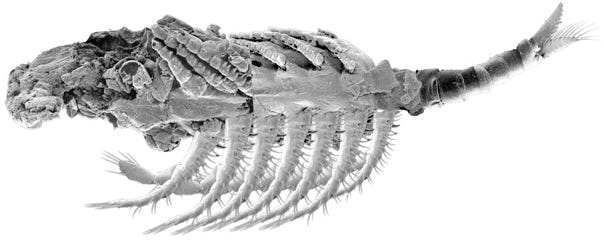
The Orsten is limestone rock from the lower Cambrian to the earliest Ordovician – i.e. ca. 520 to 490 Million years old – in the form of nodules or layers. By etching the limestone away, minute animals were discovered, where phosphatic matter had preserved the surface of them in such a fine way that they were fossilized as not-compressed three-dimensional carcasses, with all details of their surface still present.
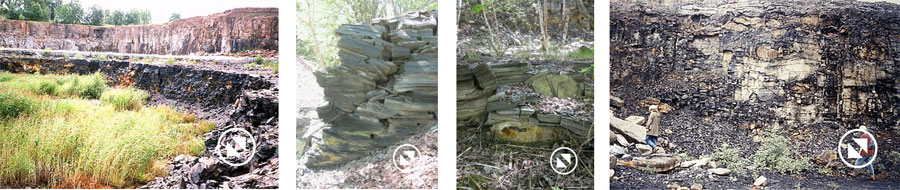
In the case of arthropod fossils, this means that the cuticle is preserved including appendages or eyes, but also surface details such as hairs, membrane folds or pores. Only shrinkage often had distorted the animals, but the tiny crustacean larvae – only 100 micrometer long – are the best preserved fossils, often being completely undistorted and blown up like little balloons. Initial sites were discovered in 1975 by the late Klaus Müller, University of Bonn, Germany, notably at the hillside Kinnekulle and on the island of Öland, all in Sweden. Successively similar fossils were discovered on world-wide scale, i.e. on all of the micro-continents which existed at that time around the giant continent Gondwana.
Home || Privacy Notice | Imprint || To top || © 2025 CORE